Art Front Stuart Davis and Thomas Hart Benton 1935
Abstract Expressionism 1935
by Gary Comenas (2009, Updated 2016, 2018)
Mayor La Guardia: "If that's fine art, I vest to Tammany Hall."
c. 1935: Milton Avery joins the F. Valentine Dudensing gallery.
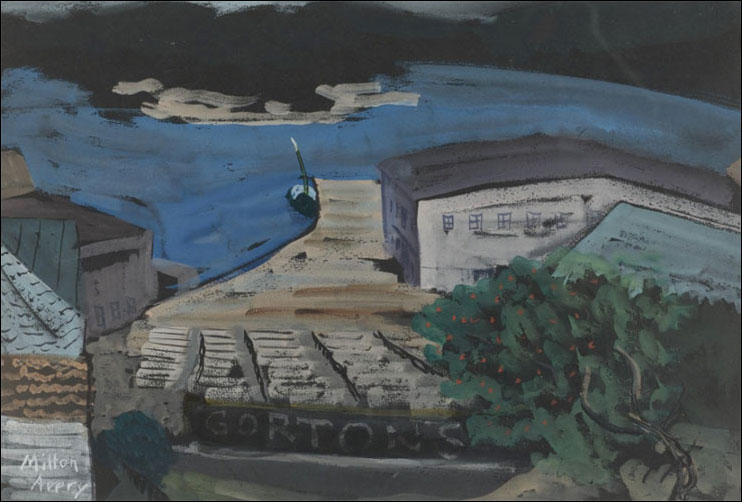
Gorton's Fishery (1935) Milton Avery (gouache on black newspaper 12 1/4 by 18 in.)
From "Milton Avery: The Metaphysics of Colour" by Barbara Haskell
in 1935, his [Milton Avery's] art elicited the praise of the distinguished critic, Henry McBride and the attending of art dealer Valentine Dudensing, who asked Avery to join his gallery. Alliance with Dudensing had a major impact on Avery'south career. Not but did Dudensing'due south support requite him a larger measure of financial security than he had known previously, it besides placed in him in frequent contact with the work of European artists such as Henri Matisse and Pablo Picasso whom Valentine also exhibited. Encouraged by their example, Avery extended his experiments with saturated colour and simplified form. His color became much bolder as he accentuated the mood of a state of affairs past discarding the constraints of naturalistic hues and favouring a loftier-key, non-naturalistic palette. The importance he placed on color and formal simplicity inevitably elicited comparisons with the work of Matisse comparisons which incited Avery's annoyance and denials of influence. While the ii artists unequivocally shared an aesthetic vision, they did, in fact, differ greatly. The reserved quietude and stillness engendered by Avery's soft, lyrical hues contrasted markedly with the voluptuous hedonism of Matisse'south more saturated palette and arabesque detailing.
Early 1935: Willem de Kooning meets Rudy Burckhardt and Edwin Denby.
Living in the building next to de Kooning's W. 21st Street apartment was Rudy Burckhardt and Edwin Denby who would become de Kooning's earliest champions and collectors. He met them while searching for Marilee (Willem and Juliet 's cat) who had escaped from their apartment onto the fire escape of the edifice side by side door. (DK144)
Feb 1 - 25, 1935: Jackson Pollock exhibits in a museum for the first time.
Jackson Pollock'due south painting, Threshers (at present lost) was included in the "Eighth Exhibition of Watercolors, Pastels, and Drawings by American and French Artists" at the Brooklyn Museum. (JP75/PP318) The exhibition also featured work past Thomas Hart Benton and more than than a hundred other artists. (JP75)
(Note: Deborah Solomon'due south biography of Pollock gives the exhibition title as "8th Biennial Exhibition of H2o Colors, Pastels and Drawings by American and Foreign Artists.")
February 12 - March 22, 1935: "Abstract Painting in America" exhibition at the Whitney Museum.
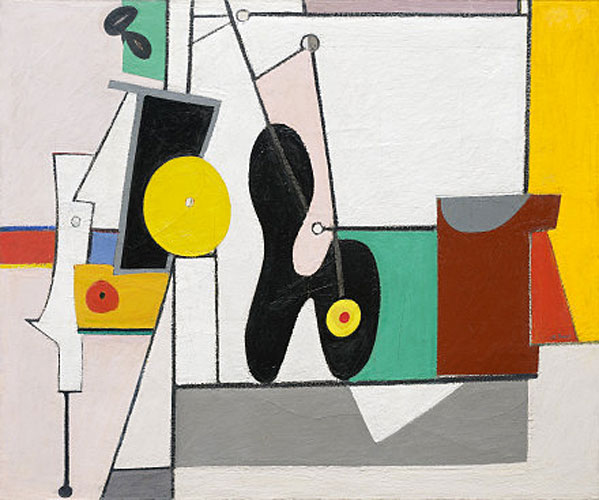
Organization (1933 - 1936), Arshile Gorky (50 x 59 13/sixteen in.) (Note: There is an inscription across top reverse: on stretcher: TOP Arshile Gorky 36 Union Foursquare 1933-1934 1936), National Gallery of Art, Washington D.C., Ailsa Mellon Bruce Fund 1979.13.3, © 1997 The Estate of Arshile Gorky / Artists Rights Society (ARS), New York
Four paintings by Arshile Gorky were included: Composition no. 1 [Cat. Rais. No. 67, p. 191] , Limerick no. 2, Limerick no. 3 [Cat. Rais., No. 78, p. 205], and Organization [Cat. Rais., No. 119, p. 250]. (BA238)
Stuart Davis' work was besides included (simply not John Graham, Willem de Kooning, Edgar Levy or Mischa Reznikoff.) Co-ordinate to the curator, Lloyd Goodrich, "De Kooning was not known at this time and very influenced. Gorky was far better known... He had the ability to see the abstruse in art of all periods, to see in Vermeer'southward work the same principle of abstract pattern every bit he did in his own period." (BA238)
Stuart Davis (from the Introduction to the catalogue):
Art is non and never was a mirror reflection of nature. All efforts at imitation of nature are foredoomed to failure... Nosotros will never effort to copy the uncopyable but will seek to institute a material tangibility in our medium which will be a permanent record of an idea or emotion inspired past nature. This being and then, nosotros will never over again ask the question of painting, 'Is it a good likeness, does information technology look similar the thing it is supposed to represent?' Instead nosotros will enquire the question, "Does this painting which is a defined ii-dimensional surface convey to me a direct emotional or ideological stimulus?" (AI431-34)
February 1935: Jackson Pollock paints a lewd mural.
According to the Jackson Pollock Chronology published by The Museum of Modern Fine art in Jackson Pollock, in February 1935 "Jackson paints a 'vast, lewd mural in the style of Orozco' on the walls of his studio at 76 West Houston Street." (PP318)
February 25, 1935: Jackson Pollock is hired as a rock cutter.
Pollock transferred from the Domicile Relief program to the Work Relief program. Initially hired as a stone cutter, he was soon demoted to rock carver helper. His main duty was to clean public monuments around the city. (JP75) He was paid $1.75 an hour. (PP318)
March eighteen - May nineteen, 1935: "African Negro Fine art" exhibition at The Museum of Mod Art.
Adolph Gottlieb attended. Gottlieb's interest in African art was fuelled by John Graham who was a connoisseur of African sculpture and was largely responsible for the selection of works in the Frank Crowninshield Drove of African Art. (AG20)
From the Sotheby'south catalogue for their African & Oceanic Fine art auction May 19, 2000 (as quoted in The City Review):
It was the artist John Graham who was primarily responsible for the range and quality of Frank Crowninshield's collection of African Art. Graham purchased many of the works in Paris, and indeed the content of the drove expressed a strong emphasis on work from the French colonies....
March 1935: Arshile Gorky's sister, Vartoosh, has a baby. (BA547)
The son was named Karlen. He would subsequently write two books on Gorky published in 1978 and 1980. His 1978 biography, Arshile Gorky Adoian, included a big selection of letters from the artist. In 1998 another biography of Gorky was published by a dissimilar author not related to the family unit - Black Angel, A Life of Arshile Gorky, past Nouritza Matossian. In her volume Matossian claimed that 29 of the artist'south letters were forgeries. (BA497)
Some other biographer of Gorky, Matthew Spender, besides claimed that in that location were problems with the letters. Spender, who married Arshile Gorky's daughter Maro, noted in his volume, From a High Identify, A Life of Arshile Gorky, that "Studying these documents [the letters] with the assistance of two Armenian scholars, we came to the conclusion that many of Karlen's translations were figments of his own fantasy of what Gorky was, or what Gorky should take been. They were extensions of the sad, strange conviction which Vartoosh had wished upon him - that his own life was a continuation of her blood brother's." (MSxxiii) Karlen died in 1990, near a year before Vartoosh.
Vartoosh, Moorad and Karlen stayed with Gorky who sold works at cheap prices in guild to purchase pigment. Bernard Davis bought half dozen paintings for $20 to $30 each. Sydney Janis paid as trivial as $10. (BA256) When an art supplier, Rosenthal, visited the studio with an IOU for $1,000, Vartoosh pleaded, "Await, I am here and my brother is supporting me and my little baby. My married man has no work." (BA256)
Vartoosh and Moorad held committee meetings in Gorky's studio of the HOK (Hayasdan Oknoutian Komite) Progressive Party, attended by Sarkis Gasparian, Vahan Gasparian and Badrik Selian. Selian recalled that Gorky "was very curious about Soviet Armenia and the Soviet Union" but "was disappointed that the art and sculpture were then backward. He couldn't understand how such a revolutionary country could be so reactionary in art." (BA258)
Vartoosh later recalled one night when, wakened by her baby in the center of the dark, Gorky was sitting in front of a sail, painting. He explained, "Vartoosh... It came to me that I accept to modify this line. If I go out it till morning I might forget." (BA259)
March 16, 1935: Germany begins military conscription in violation of the Treaty of Versailles.
April 1, 1935: Philip Guston appears in Time Mag.
The article was nearly the Mexican mural, The Struggle Against War and Fascism, painted by Guston and Reuben Kadish in 1934. The article, referring to the fresco as "ane of the biggest, most constructive frescoes in all Mexico" noted that information technology was "painted not by one of Mexico's famed group of revolutionary muralists, only by a pair of young, talented, enthusiastic U.S. citizens from Los Angeles."
From the Time magazine article:
"The project was started terminal summertime when regime in Michoacan'due south country university realized that they had in their museum a huge wall, unbroken except for one small balcony. To Mexican eyes this bare space cried aloud for a great mural such as decorates the main public buildings in United mexican states City... Painters Pablo O'Higgins and David Alfaro Siqueiros persuaded the Michoacan University trustees to give this opportunity to two young men one of whom had helped Siqueiros cease a fine fresco in the Workers' Cultural Center in Los Angeles two years earlier: Reuben Kadish, 21, and Philip Goldstein [Philip Guston], 22.
... The impoverished Michoacan University announced that it could afford to pay the painters' living expenses for but six months. Kadish & Goldstein jumped at the chance, packed upwards for afar Michoacan, rolled up their sleeves and with only one assistant, 23-year-one-time 'Itinerant Poet' J. H. Langsner, painted ane,024 sq. ft. of true fresco in the required 180 days.
... The huge wall, when finished, showed with gripping realism love to the Mexican heart the Workers' Struggle for Liberty. The left half of the primary wall depicted nude workers knocking from a ladder... In the centre is the cleaved-necked body of a hanged woman and above her a hooded and villainous priest. The other half of the wall is given over to the Modern Inquisition. Nearly the floor is the torso of an electrocuted human, realistically rigid. Rise through a trap door are ii hooded figures representing the Ku Klux Klan and Nazism. In the farthermost upper right, Communists with sickle & hammer are rushing to the rescue. Crowed Patron-Discoverer David Alfaro Siqueiros last week: 'Information technology is my honest conventionalities that Goldstein [Guston] & Kadish are the almost promising immature painters in either the U.Due south. or Mexico." (TW)
The article was illustrated with a photograph of Kadish, Guston and Langsner standing in front of the mural.
April 24 - 27, 1935: The first Writers' Congress takes place.
The Congress is referred to by different names in different sources. Many writers only refer to information technology as the Writers' Congress. In Black Affections: A Life of Arshile Gorky by Nouritza Matossian, it is called the "First American Writers' Congress of Communist Party Writers." (BA239). In Lewis Mumford's opening speech for the American Artists' Congress (see 1936) he referred to the group behind the Writers' Congress as the American Writers' League. (AA62) Co-ordinate to FBI files, "the League of American Writers was launched by the First Congress of American Revolutionary Writers. The Congress was held in Mecca Temple, New York City, on Apr 24 through 27, 1935."
From the introduction to Artists Against War and Fascism: Papers of the Showtime American Artists' Congress by Matthew Baigell & Julia Williams:
The first Writers' Congress, similar earlier antiwar congresses abroad... was non, properly speaking, part of the Popular Front; but information technology was function of a looser initiative known every bit the United Front end. The United Front end was antagonistic to the capitalist democracies, associating them with fascism. It openly supported the Soviet Union and wanted to increment 'the issue of propagandist literature.' In its view, President Franklin D. Roosevelt was on par with Adolf Hitler or Benito Mussolini. The position of the United Front was conspicuously expressed in the Political party mag, the Communist, in March 1935. 'The Party's general line in this period is to mobilize the masses against capitalist reaction and fascization, confronting war preparations, and for the defence of the Soviet Union, on the basis of the united front policy...' The position was reversed abruptly with the institution of the Popular Front in August 1935. The Soviet leadership developed the Popular Front strategy because it believed the war between Germany and Russia had become unavoidable... Through the Popular Front the leadership sought antifascist allies wherever they might exist plant... This sharp change of strategy called for working with people and organizations previously considered enemies: with anybody, even anti-Communists, sympathetic to the fight against fascism... (AA6-7)
April 1935: Thomas Hart Benton leaves New York.
Jackson Pollock'south mentor, Thomas Hart Benton had been offered the job of director of the Kansas City Art Institute. (PP318) Benton, who was originally from Missouri, decided to return to the midwest, settling in Kansas Metropolis. He had become frustrated with attacks on American Scene painting and the embracement of Communism past artists like Stuart Davis. In the Apr 1st issue of Art Front, Stuart Davis had referred to Benton as "a piffling opportunist... who should have no problem selling his wares to any fascist government." In the April 15th issue of Art Digest, Benton wrote "Communism is a joke everywhere in the U.s. except New York." (JP76)
Pollock was devastated by the news that the Bentons were moving. They had been like family to him. According to Manuel Tolegian when the Bentons left, Pollock "was truly a lost soul" who "took to heavy drinking, even spoke to me of suicide a number of times." (JP77)
May 1935: The Theater Troupe, managed by Barnett Newman, performs one-act plays.
Alexander Borodulin was the in-firm playwright for the Theater Troupe which performed the one-act plays at the Artef Theatre on 247 W 48th Street.
Early May 1935: The germination of an artists' congress is discussed.
According to the introduction past Matthew Baigell and Julia Williams in Artists Against War and Fascism: Papers of the First American Artists' Congress, "A week or ii after the National Writers' Congress... Alexander Trachtenberg (whom Stuart Davis called 'Comrade Trachtenberg') attended a John Reed Club coming together (which Davis called a 'Society fraction') to discuss the germination of an artists' congress." (AA8)
The source for the information almost the coming together of artists mentioned by Baigell and Williams comes from Stuart Davis' penciled notes. According to Virginia Hagelstein Marquardt ("Fine art on the Political Front end in America - From The Liberator to Fine art Forepart," Art Journal (Spring 1993)), the John Reed Club had disbanded in 1934 - possibly the reason why Davis referred to the meeting as a 'Gild fraction' rather than a regular coming together.
According to Baigell and Williams, a committee of twelve John Reed Club members was formed to consider the formation of an artists' congress. (AA9)
Spring 1935: Barnett Newman takes a teaching class.
Newman took "Teaching Oral English in High Schoolhouse" at the City College of New York. (MH)
Spring 1935: Willem de Kooning's mother arrives from Holland.
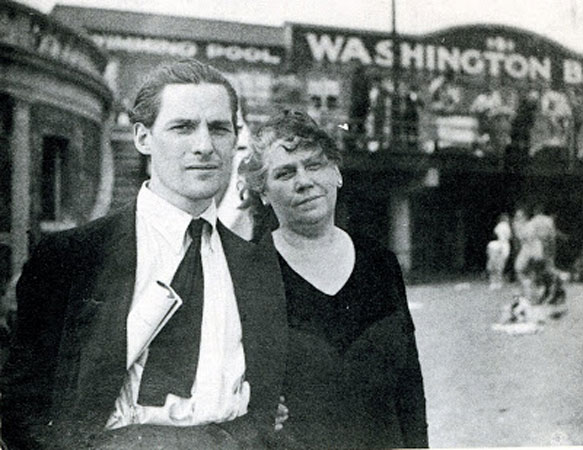
Williem de Kooning and his mother, Coney Island, 1935
(Lensman unknown)
De Kooning's mother, Cornelia, was under the impression that her son was married to Nini Diaz based on past correspondence with him. So, before his mother visited, De Kooning (who was actually living with Juliet Browner at the fourth dimension) rented another apartment with Nini and stayed there with Nini during his mother'southward visit. However, it somewhen came out that not only were de Kooning and Nini non married, in that location was another woman involved (Juliet) and, to make matters worse, his mother also found out about Nini's previous ballgame. (She didn't know that during her stay, de Kooning had made Nini pregnant once more, necessitating some other abortion - a botched job which left Nini unable to conceive.) (DK120)
May 6, 1935: President Franklin D. Roosevelt announces the germination of the Works Progress Administration (WPA).
One of the WPA'due south subprograms was Federal Project Number One for which $300 meg was appropriated for theater, music, writing and the visual arts. Holger Cahill, who favoured representational painting with a predilection for Mexican muralists, was put in charge of the visual arts section. (DK121/124)
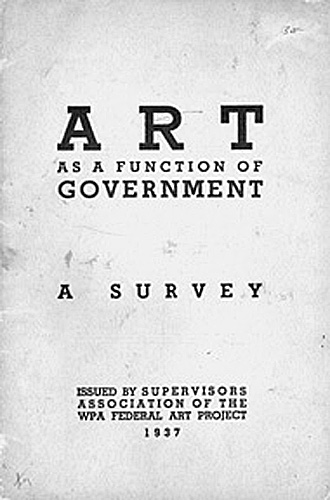
In 1937 the Supervisors Association of the WPA Federal Art Project issued a 32 folio survey of "Art as a Function of Regime"
On August 2, 1935 the Federal Art Projection was launched equally a subprogram of the WPA in club to further extend work relief to artists. Often the Federal Fine art Project is simply referred to as the WPA in fine art histories and biographies.
Meet The WPA and the Federal Fine art Project.
May 18, 1935: The beginning organizational meeting of the American Artists' Congress takes place.
The offset organizational meeting of the Congress took place at the studio of Eitaro Ishigaki nether the guidance of Alexander Trachtenberg. Twenty artists attended. A second meeting was held on June 10 and a third meeting on June 24. (AA9) Stuart Davis accepted the position of executive secretary and would later become the chairman. Throughout the summertime the planning commission met every Fri evening at the ACA Galleries. (AA10)
At the second coming together artists Stuart Davis, George Ault, Hugo Gellert and Louis Lozowick, along with critic Jerome Klein, were asked to draft a "Telephone call of the American Artists' Congress." At the third meeting the Lozowick's draft of the "Call" was rejected for "lacking the qualities of a manifesto" and another committee was formed consisting of Stuart Davis, Aaron Douglas, Hugo Gellert, Ben Shahn William Siegel and a person named appeared as "Schang" but was probably Saul Schary. The new call was approved past early August at which fourth dimension the organization had grown to l-half-dozen artists. (AA9) By Oct, when the call was printed in the Oct 1st consequence of the New Masses, the organization had 114 members. By the time of the commencement meeting it had 401 members. By 1939 it had over 900 members. (AA10)
1935: Clyfford Still receives a Master of Fine Arts caste from Washington State.
His xxx-four page M.A. thesis was Cézanne, A Study in Evaluation. (RO226)
June xviii, 1935: Germany signs the Anglo-German naval understanding.
On June 18, 1935, the Germans signed the Anglo-German naval understanding with the British which allowed Germany to increase the size of its Navy to 35% of the size of the Imperial Navy in violation of the Treaty of Versailles. When the understanding was signed Hitler commented "Great Britain has in fact renounced her naval influence in the Baltic, a canteen that nosotros Germans can shut. The English cannot exercise any control there. Nosotros are the masters of the Baltic."
Summer 1935: Hans Hofmann opens his summertime school in Provincetown. (DK284)
Summer 1935: Clyfford Still spends a second summer painting at Yaddo. (RO225)
Summertime 1935: Barnett Newman rents a studio at 234 West 13th Street. (MH)
Summer 1935: Robert Motherwell goes to Europe for the first fourth dimension.
While all the same a student at Stanford he spent the summertime of 1935 visiting Europe, traveling to France, Italian republic, Switzerland, Germany, Kingdom of the netherlands, Belgium, England and Scotland (including the town of Motherwell, near Glasgow). (RM)
Robert Motherwell:
That [the trip to Europe] mainly had to do with my father. After years of struggle finally he was in an established position. He had never himself been to Europe. He was a very classical, traditional Scotsman. He thought it would be a very nice idea to brand the m tour of Europe every v years. He planned information technology for my mother, my sis and myself. My mother decided that she didn't desire to get, that she would rather take her share of the money for the trip and partly remodel our barn in Westport. And then my male parent and my sis and I went. We made the grand tour of Europe starting in Paris and going all the mode to Amalfi, all the way upwards Italy and Switzerland, Frg, the Low Countries, London and concluded in Motherwell, Scotland. Then came home again. Then, of grade, 1940 would accept been the next trip but the war had begun. And by 1943 my father was dead...
My male parent planned the trip very carefully. We were gone -- I don't know -- two months. We would stay three days in each city. And he did something very intelligent. The commencement day a motorcar and a driver and a guide would meet us at the hotel and take us all effectually the urban center in the morning. And so nosotros would cease and have lunch. The car would pick the states up over again and either have us to more places or take the states back to something that we wanted to see more of. And having done that in 1 24-hour interval yous had a terrific sense of the whole place, and and then at leisure the next couple of days would do what y'all wanted to do. And, of grade, my father was stunned at my knowledge of art. For some reason traveling is mainly looking at fine art, though well-nigh people hate art. Just I actually liked it and knew almost. Oft I knew better than the guides what nosotros were looking at. They'd make terrible mistakes. Merely non speaking any of the languages I couldn't explain to them very well. I couldn't fifty-fifty pronounce some the of the names. So for me it was a feast of the center and a sense that I however have of Europe of its being much more pleasurable, agreeable, comfortable, and food and wine. My father was a great gourmet, and there's where we actually met. He was looking at information technology from an entirely different standpoint -- he was very interested in agriculture, in the manufacturing, in all mod techniques of doing things, he was also very aware that the war was coming and, as an international broker, he was very concerned about it. So he was looking at Europe all the time economically. I was looking at it all the time aesthetically and humanistically. So that he liked Deutschland, Switzerland and England, that he didn't get whatever fake money, and that the bathrooms were clean, that people were well-organized. I liked France and Italy, I mean the food was much better, where the art was much amend, and the people were much juicier, the climate was much sunnier, and then on. It was very naive really; it was the Innocents Abroad. But a real revelation. (SR)
Summertime 1935: Adolph Gottlieb visits Paris.
While in Paris, Gottlieb bought several pieces of African sculpture from dealers recommended by John Graham. (AG20)
Adolph Gottlieb:
... in 1935 my wife and I took a trip to Europe and spent a lot of fourth dimension in Paris. I had some connections in that location with people who handled primitive art. So I bought a fleck, I bought a few pieces. I didn't have much coin or else I would take bought a not bad deal. However, I had been interested in African fine art long before that because the interest was angry by the involvement the Cubists had in African fine art and as well there were very famous collections that you could encounter in New York. A friend of mine, John Graham, had a marvelous collection. He was collecting things for Frank Crowninshield. Helped assemble that collection and besides did a lot of things I believe for Helena Rubenstein. So I was associated with people who had an intense interest in this thing and I had the opportunity to run across very adept pieces and I read any I could about it so that I became quite familiar with it... I have been buying things on and off e'er since. (As)
July 1935: TRAP is formed.
TRAP, the Treasury Relief Art Project, was initiated with funds from the Works Progress Administration (WPA). Its purpose was to hire five hundred artists to decorate about 1,900 public buildings, mostly post offices. Initially, 90 percent (afterward 75 percent) of the artists working for TRAP had to first be eligible for relief after being investigated by Emergency Relief Bureau social workers. Applicants had to be unemployed and could non exceed the prescribed allowances of $ix.30 a calendar month to feed an adult male person and $7.70 a calendar month for a female. After July 1937, participants in the program were besides required to be American citizens. (RO119-twenty)
July 25 - Baronial 1935: The Pop Front is endorsed by Moscow at the Comintern'southward Seventh Congress.
The official decision to accept the support and alliance of sympathetic groups (such as intellectuals and artists) who were non necessarily Communists to fight against Fascism under a Popular Front end was taken at the Comintern's Seventh Congress. However, the idea of a Pop Front was discussed much earlier than the Congress and the Franco-Russian military pact in May 1935 tin be seen every bit a prior case of the Soviet government's relaxation of their previous hardline approach confronting allying themselves with not-Communists.
August 2, 1935: The Federal Art Project is launched.
The Federal Fine art Project is ofttimes referred to as the WPA (Works Progress Administration) only was actually a subprogram of the WPA which came about after Harry Hopkins, the head of the WPA, argued to extend work relief to artists, perceptively noting that "Hell, [artists] have got to eat simply like other people." (DK124)
Willem de Kooning:
The Project was terribly of import. it gave united states of america plenty to alive on and nosotros could paint what nosotros wanted. Information technology was terrific largely considering of its director, Burgoyne Diller. I had to resign after a year because I was an alien, but fifty-fifty in that curt time, I inverse my attitude toward being an artist. Instead of doing odd jobs and painting on the side, I painted and did odd jobs on the side. My life was the same, only I had a different view of it. I gave up the idea of showtime making a fortune and and so painting in my former age. (IS50)
Not everyone agreed that artists should receive state support. The Hearst press was particularly negative about the Federal Fine art Project, referring to the artists who participated as "Hobohemian chiselers" and "ingrates." (MM27)
Encounter The WPA and the Federal Art Project
Apart from a guaranteed paycheck, the WPA, along with the Artists' Union, also performed a social function, enabling artists to meet other artists. Willem de Kooning would afterward say, "The projection was so proficient. It brought us all together in a friendly mode." Friday was payday and the artists would collect their checks, nourish meetings at the Union and get together at Stewart'south Cafeteria located on Twenty-third Street off Seventh Avenue, about two blocks from the Union headquarters. (DK148/IS23)
Joseph Solman, i of the founders of the artists' group known as "The Ten" (which included Mark Rothko, Adolph Gottlieb and John Graham), was also active in the Artists' Union and hung out at Stewart's:
Joseph Solman:
After meetings at the union we'd get in for coffee and a sandwich or whatever and stay up to about 2 in the forenoon... Nosotros'd talk about the different phases of art, the shows of Picasso, de Chirico, Klee, the Whitney Museum. And we'd talk nigh the exciting shows that we saw effectually the boondocks. (DK129)
Two other artists' hangouts during the 1930s were the Haven Bar, located across the street from Stewart's and the Horn & Hardart Automat. (DK148)
August 1935: Charles Pollock moves to Washington D.C. from New York.
Jackson Pollock's blood brother Charles was employed by the Resettlement Administration in Washington D.C. (PP318)
Baronial 1935: Jackson Pollock joins the Federal Art Project.
Both Jackson and his brother Sande joined the landscape sectionalization of the project. Sande inverse his last name to McCoy to avoid the WPA stipulation of simply one cheque per household. (PP318)
Jackson found information technology difficult to to obey the regulations and deadlines of the Project. Some of his paintings were returned for more work and some were rejected outright. At i indicate while he was still with the Projection, Pollock wrote to his blood brother Charles in Washington D.C. "... not having much luck with painting. Got my last flick turned back for more time... if information technology had been a good picture I wouldn't accept consented." (JP82-83)
August 1935: Arshile Gorky joins the Federal Fine art Project.
After being dropped from the Public Works of Art Project on Apr 29, 1934 Gorky received no federal aid until July 1935 when he applied to the Emergency Relief Bureau and was granted $24 a week. In August he was accepted as a "Master Creative person" in the Mural Division of the Federal Art Project at $103.twoscore a month. This would afterward be decreased to $91.16 in Nov 1938 and to $87.sixty in July 1939. Holger Cahill, a friend of Gorky, headed the Federal Fine art Project. Some other of his friends, Burgoyne Diller headed the Landscape Sectionalization. (HH237)
Baronial 1935 - 1936: Philip Guston and Reuben Kadish paint the1935-36 mural, Concrete Growth of Human being, at the City of Hope visitor'south centre, Duarte, California. (SK)
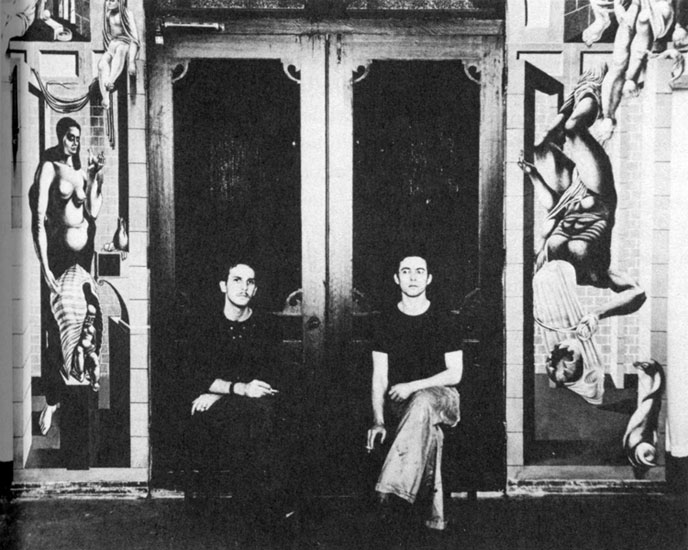
Philip Guston and Reuben Kadish in forepart of Physical Growth of Man
Annotation: This photo is captioned "Phil Goldstein and Reuben Kadish in forepart of mural on which Sande Pollock assisted" in the Naifeh and Smith biography of Jackson Pollock.(JPN261) According to Reuben'due south nephew, Skip Kadish, the photo is actually a picture of Guston (née Goldstein) and Kadish in front of the landscape chosen the Physical Growth of Man in the City of Hope visitor center (a medical establishment) in Duarte, Ca (near 50.A.), painted August 1935-July 1936. Skip Kadish has "plant no evidence of Sande McCoy profitable Goldstein and Kadish on the Duarte mural." (The photograph was originally provided to Naifeh and Smith by Reuben Kadish.)
September 1935: Jackson Pollock moves dorsum to 46 East eighth Street.
Jackson Pollock'south brother Charles and his wife Elizabeth had vacated the apartment in Baronial when they moved to Washington, D.C. where Charles worked for the Resettlement Administration every bit a staff artist in the "special skills" division. (His fellow workers included Ben Shahn.) When Charles moved from New York he left his Model T Ford behind and then that his brothers could utilise it.
Jackson had originally lived in the apartment with Charles and Elizabeth when they moved at that place in April 1933, renting an entire floor for $35. In the autumn of 1935 he moved briefly to a brownstone on 58th Street before returning to 46 East 8th Street later Charles left for Washington, D.C. (PP317/318/JP85)
c. Late September 1935: Philip Guston moves to New York and changes his proper name.
In a letter to Reuben Kadish dated Baronial 27, 1935 Philip Guston wrote "The all-time thing that is new with me is that I am going to New York in three weeks - most the 20th of September. I saw Tolegian, he is here for a few weeks - and he tells me that I will take a better take chances to on the the [Federal Art] projection around this time than after in the fall." (DA32-3)
When Guston moved to New York he initially stayed with Jackson Pollock and his brother Sande in their loft at 46 East 8th Street, afterwards moving to a small loft on Christopher Street. (DA34)
During the same year, he changed his name from Phillip Goldstein to Philip Guston.
Musa Mayer [Philip Guston'southward daughter]:
As if to underscore this move [to New York]... my father, in 1935, when he was twenty-two, started using the name Guston and spelling his get-go name with ane "l"... Later, deeply ashamed of his human action, my father concealed his proper noun change, and asked his biographer Dore Ashton to avoid any reference to it in her book. I didn't know about this change of proper noun until I was in college. (MM22)
Later Guston's death in 1980, his married woman, also called Musa, told their daughter that "He [Philip] never forgave me" for "making him alter his name." She showed their daughter a painting from 1935 on which he was still using his real proper name. Information technology was signed Phillip Goldstein, 1935.
Musa Mayer:
My female parent showed me the place where, on ane of his primeval paintings, Mother and Child from 1930, he had repainted his before signature, carefully matching the pigment to muffle the alter... Philip's story - as I learned later, from reports of guilty confessions he'd made to friends - was that he'd decided on his ain to modify his his name, before even coming together her parents, and that my mother had been against information technology. He'd been certain her parents would have a Guston more readily than a Goldstein as their son-in-law. (MM229)
After moving to New York, Guston would occasionally return to live with his mother but ultimately had little contact with his family. Guston's daughter, Musa, recalled that she met her grandmother only one time. He returned to Los Angeles in 1949 when his mother died and again in 1959 when his sister, Jenny, died. (MM17)
September - October 1935: Arshile Gorky solo exhibition of pen and ink drawings at the Boyer Galleries, Philadelphia. (BA547)
During the exhibition Gorky lectured on abstract painting. Co-ordinate to Dorothy Miller "That awful man Boyer stole a groovy many drawings from him." (BA240)
September 30 - Oct 24, 1935: Fernand Léger: Painting and Drawing exhibition at the Museum of Modern Art.
Arshile Gorky attended the exhibition and, co-ordinate to Anna Walinska, told her that "Léger was ane of few artists who reconciled the figurative image, the breaking of space and color and the line - that linear chemical element ties them all together." (BA243)
c. 1935: Hugh Stix opens the Artists' Gallery.
It was at Stix's gallery that Adolph Gottlieb first showed his semi-abstract Arizona desert paintings in 1940 - considered to be precursors to his Surrealist pictographs. Stix celebrated the twentieth anniversary of his gallery in 1955 past selling unsigned drawings by established artists among the work of relatively unknown artists and refused to tell any of the potential buyers which drawings were by which artists. All were sold at the same price - $25.
From "I for the Prove," Time magazine, September 26, 1955:
To all outward appearances, the possessor of Manhattan's Artists' Gallery was behaving last week similar the Madman Muntz of the art dealers' world. On the walls of his Lexington Avenue walkup were hanging drawings by 204 artists. Side by side with relative unknowns were works by such superlative U.Due south. moderns as Lyonel Feininger, William Baziotes, William Cropper, Philip Evergood and Josef Albers worth upward to $250. Each cartoon was marked at a flat $25. The only hitch: on none of the drawings was the artist'due south signature visible, and the gallery refused to say who had drawn what. The bargain show was simply another way for the gallery's businessman-founder, Hugh Stix, 48, a former Harvard Fine Arts laurels graduate and at present a total-time wholesale grocer, to underline his credo: "Somebody has to like art for what it is, not just for the artist's name.'
... Amongst New York City's 150-odd art galleries, Hugh Stix'due south Artists' Gallery is unique. Running it as a nonprofit venture, Stix reverses the traditional art dealer's one-for-the-money, two-for-the-show policy, hangs pictures and takes no commission, shows mainly unknowns, and does everything in his ability to pass along his discoveries to other dealers. All the drawings in the current show were donated by grateful alumni or well-wishers to gloat the opening of the gallery's 20th season.
Stix started his gallery in a Greenwich Hamlet loft during the Low. His aim was to help out artists who, then equally now, were galleryless. The opening was a shock: with 500 invitations out and 72 chilled martinis and Manhattans ordered up from the bar downstairs, Stix sweated through 2½ hours before his first—and but—guest showed up. The invitee turned out to be an creative person wanting a show for his watercolors. Merely today the gallery is a must for art critics and gallery owners on the hunt for dark horses...
Over the years, Stix has started more than than 100 artists, including Adolph Gottlieb, Ben-Zion, Ad Reinhardt, James Lechay and Richard Pousette-Sprint, on their ways to regular dealers.
c. October 1935: "26 Works by Giorgio de Chirico" exhibition at the Pierre Matisse Gallery. (BA243)
October 13, 1935: Franz Kline arrives in England.
Franz Kline left Boston, traveling to England by boat. On board the South.S. Georgic (second course) he met Frank Hahn. Afterward docking at Southampton Hahn and Kline made their way to London, renting a apartment on Belsize Crescent in the London borough of Camden. (FK176)
Franz Kline [1961]:
My female parent was English. I'd hoped to get to England and then on to study in Paris, but I never got to Paris at that time. As a thing of fact, terminal year [1960] was the first time I ever went to Paris or the Continent. (KK153)
Kline practical for British citizenship while in the country but in society to qualify he had to constitute residence there for eight years without working. While in England he worked briefly equally a brandish artist at Selfridges (see September 1937) and also earned a picayune from commissions. In 1937 he was deputed to make copies of portraits by Edmund Havell by his (Klein'due south) future in-laws. Kline reproduced the works, including the artist'southward signature and appointment. The subjects were the grandparents of his future father-in-constabulary. (FK166n38)
Soon afterwards arriving in England, Kline acquired a book by an English caricaturist, Phil May'southward ABC (London, 1897). The following twelvemonth, on August 10, 1936, Kline wrote to a fellow art student in Boston that "Past now I have ten books on him [May], some first editions, and so yous see I still have Quondam Phil in the claret." Several of May'due south books were also found in Kline'southward studio later on his decease in 1962. (FK166n34)
From Franz Kline by Harry F. Gaugh (NY: Abbeville Printing, 1985):
Kline's favorite pen and ink artist was Phil May (Phillip William May, 1864 - 1903), an English draftsman whose drawings he had kickoff admired in Boston. He talked often in London about May and [Charles Samuel] Keene, but believed May the greater artist because with a unmarried stroke, rather than cross-hatching, he could convey the shape and shadow of a form. Kline collected books filled with reproductions of May's drawings of seedy old men, dowdy ladies, and street ruffians. He also received three original May pencil drawings as gifts from his erstwhile high school English teacher, Mathilda A. Roedel, who visited him in London. (FK33)
October 1935: Arshile Gorky exhibits at the Club Fine art Gallery at 37 Westward 57th Street.
The exhibition included fourteen drawings and four paintings, including Enigmatic Triptych, Nighttime, Enigma and Nostalgia, Composition and Detail for Mural. Katherine Dreier of the Société Anonyme purchased one of the Nighttime, Enigma, Nostalgia drawings. (BA243-244)
The New York Times (October 13, 1935) reported, "Archile Gorky's handsome abstract decoration... may be said to dominate the bear witness." (BA242)
Anna Walinska [possessor of the gallery]:
He [Gorky] was full of a rich, warm, manly, serious enthusiasm about life and piece of work. In that location was no question near the importance of art and what he was doing and how he felt about the other artists and the art world. it was easy to feel alienated at that fourth dimension, Americana, flag-waving. He would come up and spend time with my Jewish family. He seemed to be a family human being. (BA243)
c. October/Nov 1935: Arshile Gorky dates Mercedes Matter.
Co-ordinate to Willem de Kooning, "Mercedes Matter was his [Gorky's] girlfriend. She was very much with Gorky. Very adept painter too." (BA246)
Like Gorky, Mercedes was a WPA artist. Co-ordinate to Gorky's biographer, Nouritza Matossian, Gorky "initiated her [Mercedes Thing] into politics, giving her Lenin and Marx to read." (BA245) Even so, when Matter invited Gorky to attend a strike with her, he preferred to remain in his studio painting.
Mercedes Carles Matter:
I went to the strike lone. We got beaten over the head and pushed into a police force wagon, driven down Park Artery past the elegant places I used to become. The police of course denied it, even thought the front page of the newspaper showed them doing it. In court we gave imitation names. Pablo Picasso, Henri Matisse! The guess didn't know the difference. (BA245)
Matter remained politically active and during a stint in jail befriended Lee Krasner - the future wife of Jackson Pollock.
Joan Marder [editor Women's Fine art Journal]
Lee [Krasner] was a Trotskyite. Her behavior landed her in jail where she befriended Mercedes Carles Matter, a fellow artist for the WPA who was having an affair with Arshile Gorky; they would remain friends for life. Mercedes Carles Matter was the daughter of painter Arthur B. Carles. In 1932 she studied with Archipenko and by 1933 began studying with Hans Hoffmann with whom she also had an affair. Lee institute credence of advanced modernism in Hoffmann's class. Hoffmann's highest compliment of a piece of Lee's work was, "This is so adept, it looks as if it had been done by a man." Through Mercedes Carles Matter, Lee became a member of the American Abstract Artists Union where she met de Kooning, Gorky, and Greenberg. Through Lee Krasner'southward connections with Thing, Calder came to see Pollock's paintings. (JZ)
Affair afterwards said nearly Gorky, "He talked nigh his childhood, almost like chanting poetry, and I didn't know if information technology was real. As nosotros walked I would look upwardly at the buildings and trees and heaven. He looked downwards at the cracks in the pavement and the road. He would see drawings. He loved lines. Definitely linear." (BA245) She recalled going to the Frick Collection subsequently it opened in December 1935 and that Gorky was peculiarly taken with Ingres' Comtesse d'Hanssonville, proverb "He certainly loved that painting. He must take stood for over an hr." (BA246)
November four, 1935 - January 5, 1936: "Vincent van Gogh" exhibition at The Museum of Modern Art.
The exhibition was accompanied by a shrewd publicity campaign focusing on the more melodramatic aspects of the creative person's life. The publicity director of the museum would later comment "we played the van Gogh show like a polo game - dribbled the brawl downward the field commencement, and then, blindside, right between the goal posts! It was a honey, if I do say and so myself." The bear witness attracted more than 140,000 visitors during its New York run and about another 750,000 visitors while traveling to other museums in the U.S. (RO139) Time magazine referred to the show as a "nail hit." (TM)
Nov 10 - 23, 1935: "American Artists' Congress Exhibition" at the ACA (American Contemporary Art) Gallery. (AA279)
Although the bodily Artists' Congress would non take place until February 1936, this exhibition gave the group a chance to proselytise for members to the Congress. The catalogue for the exhibition included a "Call" for participation by artists to join the Congress. This original Call for participation included text that was subsequently deleted from the official Call as issued by the Congress.
Text from the original Call that was later deleted:
The Artists' Congress, to be held in New York Urban center, Feb 15, 1936, will have as its objective the formation of such an organization. Give-and-take at the Congress volition include the following:
Fascism and state of war, racial bigotry; preservation of civil liberties; imprisonment of revolutionary artists and writers; federal, country, and municipal fine art projects; municipal fine art gallery and center; federal art bill; rental of pictures; the fine art schools during the crisis; museum policy in the low; subject area matter in fine art; esthetic directions, relations of media and material to art content; art criticism.
Nosotros artists who have signed, representing all sections of the United States, ask you to show your solidarity with us past signing this Call and by participating in the Congress. (AA278)
November 24, 1935: Arshile Gorky gives a lecture, Methods, Purposes and Significance of Abstract Art, at the Guild Fine art Gallery. (BA244)
Late Nov 1935: Franz Kline moves to Bayswater.
Franz Kline and his flatmate, Frank Hahn, who Kline had met on the boat trip from the U.S., were evicted from the apartment they had taken in Belsize Crescent for taking too many nighttime baths in the oversized bathtub in the flat. They found new accommodation at 28 Queensborough Terrace in the Bayswater expanse of London. (FK176)
Tardily November or December 1, 1935: Arshile Gorky submits preliminary studies to the Federal Art Project (WPA).
Burgoyne Diller, head of the Landscape Sectionalisation of the Federal Art Project, assigned Arshile Gorky to do sketches for a mural about aviation for the Administration Building of Floyd Bennett Field in Brooklyn. Diller wanted the mural to comprise enlargements of photographs of airplanes and airports by Wyatt Davis. (HH264) The regional director of the WPA/FAP gave specific instructions for the artwork for the airport: "photo-murals and mural paintings will be based on the depiction of forms which evolved from aerodynamic limitations." The subject affair was to be based on "early legends and stories of man'south aspiration to fly in a romantic period," portraying "the kickoff attempts to build flight car, through a combination of painted and photo-murals." (BA249/517) Gorky ignored the stipulations. Rather than doing a realistic representation of early aeronautic history, he wanted to give the viewer a sense of the sensation of flight despite the fact that he had never actually been in an airplane.
Gorky, accompanied by Wyatt Davis, visited an airplane factory, Republic Aviation, in Farmingdale, Long Island in preparation for the sketches. The event was the sketches/collage he submitted to the FAP/WPA prior to December two, 1935. Another, more than conservative muralist, Eugene Chodorow had also submitted work to be considered. (BA249/HH264)
Peter Busa [fellow WPA creative person]:
He [Gorky] approached the landscape like a natural, mechanical drawing, like a lofting cartoon, getting the fuselage and fairing in the lines. Took an aspect of the fly and an attribute of the rudder. He used that proportion like Cubists did, showing you pinnacle summit, front view and end view. If you see the various sections, it'southward not a realistic plane, but sections which were taken from the lofting. (BA250)
Busa later on recalled a favourite phrase of Gorky'south: "Annihilation that's artificial is closer to fine art. Not the useful object but the useless object." (BA249)
On December 2, 1935 Audrey McMahon, the regional director for the Federal Art Project/WPA wrote to Alfred Barr for his opinion nearly Gorky's and Chodorow's proposals for the mural and Barr preferred Gorky'due south saying that, "with its photograph-montage" it would be "far livelier and more interesting." (HH264) McMahon wrote to to Barr three weeks later saying that the City Fine art Commission had not even so taken whatsoever activity regarding Gorky'southward proposals just that his sketch (sometimes referred to as collage) and a small print of his photograph mural project would exist in an exhibition at the Federal Art Project Gallery - "Murals for Public Buildings" - to open on Dec 27, 1935. (HH265)
December 1, 1935: Mark Rothko and his wife move to Groovy Jones Street in Greenwich Village from Park Place in Brooklyn.
On his naturalization application Rothko indicated that he had been living at 100 Dandy Jones Street since Dec 1, 1935. (RO589n65) The address also appears on his TRAP papers from May 1937. (RO141/589n61). It was as well the accost listed for Rothko in the catalogue for the second Almanac Exhibition of the American Artists Congress in the spring of 1938.
Late 1935: "The Ten" are formed.
see The Ten: Nine Artists in Search of a Cause
Late 1935: Willem de Kooning quits A.S. Beck to devote himself to fine art.
The Federal Art Project (through the WPA) enabled de Kooning to make the motility. Without a job he would be considered impoverished and eligible for a bacon through the Federal Fine art Project. (DK122)
It was while he was working for the Federal Art Project that de Kooning probably start met the fine art critic, Harold Rosenberg. According to de Kooning'due south biographers "Different [Clement] Greenberg, Rosenberg genuinely liked most artists." (DK222) De Kooning was probably introduced to Harold Rosenberg past Ibram Lassow who at the time was sharing a downtown loft with Max Spivak who was working on a large mural for the WPA. One of Spivak'southward administration on the mural was Harold Rosenberg:
Ibram Lassow:
Harold would exist sitting in an sometime Morris easy chair next to the keen big pot-bellied stove. In those days, that's how nosotros had to heat the space. He'd be reading. We didn't care. Nosotros knew he was a writer and respected his opinions. Every once in a while he'd expostulate: 'Did you lot ever hear anything more than stupid than this?' He'd be reading a book by Stalin. He was and so anti-Stalinist. (DK222-23)
In 1938, Rosenberg would become the national arts editor of the WPA'southward American Guide series. (DK223) Approximately four years later on a volume of his poems was published titled Trance Higher up the Streets. During the late forties and fifties, when Rosenberg established his reputation for fine art criticism, he visited de Kooning regularly in his studio - "3 or iv times a calendar week" according to de Kooning'southward biographers. (DK223)
December 1935: Nutsy moves in with Franz Kline.
Martha ("Nutsy") Kinney arrived in London and moved in with Kline and Frank Hahn in their Bayswater flat. (FK176)
Dec 1935 - January five, 1936: Arshile Gorky exhibits (once again) at the Society Art Gallery at 37 West 57th Street.
Howard Devree [The New York Times (Dec 22, 1935)]:
Most of the present group of drawings are merely numbered and treated, rightly, as rather powerful compositions in rhythm and arrangement. The affixing of such titles as Night Fourth dimension Nostalgia to others certainly does them no service. All bear witness to the artist's vigorous and personal draftsmanship. They are neither mere decorative essays nor are they mere geometric patterns, but serious attempts to express certain spatial and linear relationships. (NN)
Dec sixteen, 1935 - January 4, 1936: "The Ten: An Independent Group" at the Montross Gallery.
The exhibition at the Montross Gallery (at 785 5th Artery) was the first by The Ten. Each of the nine members of showed four paintings.
Howard Devree [The New York Times (December 25, 1935)]:
Possibly they [The Ten] can exist loosely grouped as 'expressionists'... While wishing them full measure out of success in their efforts to exist individual, I personally feel that in that location is much needless obscurity and reasonless distortion in most of the work, rather than whatever hit originality... Here and at that place are notes reminiscent of Klee, Rouault or the less geometrical abstractionists. Nigh of the pictures, moreover, seem to me to accept no such paint quality, cartoon, compositional entreatment or message as to need for them very serious attention. (NN)
see The Ten: Nine Artists in Search of a Cause
Dec 27, 1935: The New York Federal Project Gallery opens.
The opening was announced in the New York Times in their Dec 27th issue nether the heading "PWA Fine art Gallery Opens Today:"
An Art gallery, said to be the showtime of its kind sponsored by the Federal fine art project of the WPA, will open today at 3:thirty PM at 7 East Thirty-eighth Street with a private showing for 600 invited guests of work done by WPA artists in the city. Mayor La Guardia, Lily Pons and other notables are among the invited guests. Beginning tomorrow the gallery will exist open to the public betwixt 10 AM and 5 PM daily except Sundays and holidays.
A review of the opening appeared in the side by side day's event of the Times. Mayor La Guardia is quoted as maxim nigh one piece of art, "If that'southward art, I vest to Tammany Hall."
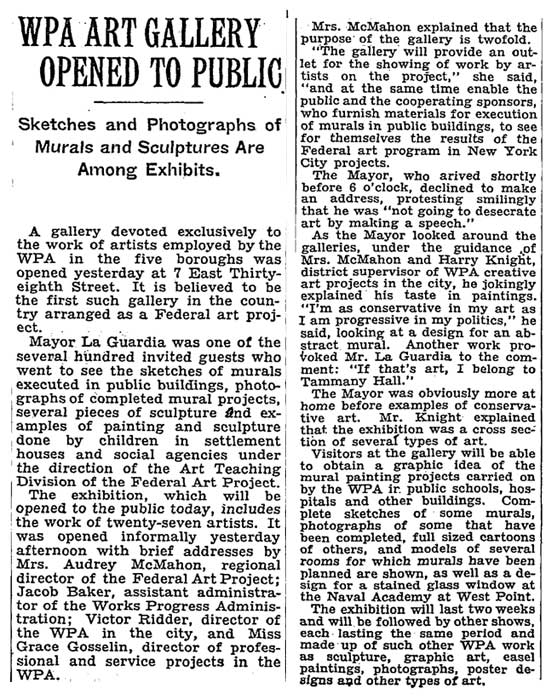
The New York Times, December 28, 1935
The inaugural testify was "Murals for Public Buildings." It included Gorky'south studies (referred to in various sources as collage, photomontage and/or gouaches) for the Floyd Bennett Field aviation mural (run into Late November/December ane above).
An account about the opening in Matthew Spender's From a Loftier Place: A Life of Arshile Gorky gave more details about the opening.
From From a Loftier Place: A Life of Arshile Gorky past Matthew Spender:
Non far along in his tour of inspection, Mayor La Guardia stopped in forepart of a sketch for a mural intended for the College of the City of New York. The title was but Brainchild. The artist who painted it was Albert Swinden, a Canadian living in New York...
'What is that?' the mayor asked. Mrs. McMahon replied that it was a design for a mural. Mayor La Guardia said he couldn't tell what it was... 'If that'southward fine art,' he said firmly, 'I vest to Tammany Hall.'
Clearly he intended the joke to be picked up and published by a reporter from the New York Herald Tribune, who was continuing behind him... According to the reporter, Mrs. McMahon immediately 'took the Mayor in hand' and led him to a nice, figurative slice of work... Meanwhile, she quickly sent an assistant downstairs to look for an artist capable of defending the position of abstractionists.
The assistant came dorsum with Gorky... Without hesitation, Gorky gave the mayor and his team the same lecture he had already delivered iii times publicly within the by two months. An abstract painter, he said, did not use 'quondam-fashioned' colors. He 'tried to testify all sides of an object at the same fourth dimension, and viewed a circular brawl equally flat.' This is the reporter's succinct version, not necessarily accurate but certainly condensed... The mayor 'wrinkled his brow,' mollified simply unconvinced. 'I'm a bourgeois in my art, as I am a progressive in my politics,' he said. 'That's why I perhaps cannot understand it.'
... The story immediately went the rounds of the cafes and bars where downtown artists met. It became a fable, and every bit with all legends, the details of the incident were twisted in the telling. The pattern for a landscape which the mayor had so disliked became, in the new version, Gorky'due south. The devastating remark 'If that'southward art, I belong to Tammany Hall,' had been aimed at Gorky." (MS147-nine)
According to Gorky biographer Nouritza Matossian in Black Angel: The Life of Arshile Gorky (based on an account past Peter Busa who was at the opening) La Guardia, upon meeting Gorky, said "Oh, yous wait like Stalin!" When Gorky explained his [Gorky's] murals, La Guardia replied "If this is art, so I'm a equus caballus's ass," adding "I am a conservative in art as I am a progressive in my politics. That's why, possibly, I cannot understand it." Gorky replied, "Mayor, yous know nigh politics. Only I know most art!" (BA250)
Not long later on the exhibition, Gorky'southward mural project was reassigned from the Floyd Bennett Field in Brooklyn to the newly completed Administration Building at Newark Airport. Burgoyne Diller later recalled that the reason for the reassignment was Mayor La Guardia'southward negative response to Gorky's abstract work every bit reported in the press. (HH267)
to 1936
Source: https://warholstars.org/abstract-expressionism/timeline/abstractexpressionism35.html
0 Response to "Art Front Stuart Davis and Thomas Hart Benton 1935"
Post a Comment